

Are Fishing Lakes Profitable? A 2026 Profit Model for Owners

A fishing lake can be a good business or an expensive passion, and the difference rarely comes from the price of a session. It comes from how many swims are taken Monday to Thursday, how much fish goes home with the anglers, and how many hours the admin eats. Below is a full profit model for a typical Romanian carp lake, with the prices lakes publish in 2026, the costs that matter, and the occupancy at which a lake starts making money. The figures are Romanian; the logic works for any fishery.
In short: a lake's profit is swims, times open days, times occupancy, times revenue per booked swim, minus costs. Fixed costs (staff, stocking, upkeep) barely change with the number of anglers. That is why, above break-even, every extra booked swim goes almost straight to profit. In the model below, a 20-swim lake covers its costs at about 19% occupancy and does well at 35%.
The formula
Annual revenue = swims × open days × occupancy × average revenue per booked swim.
Profit = revenue, minus variable costs (the ones that grow with every angler), minus fixed costs (the ones you pay anyway).
- Open days. Many lakes run from March to October or November. Others open all year, with lower winter prices.
- Occupancy. The share of available swim-days you actually sell. 35% sounds low, but it means, for example, weekends nearly full and one swim in five taken during the week.
- Revenue per booked swim. The fishing fee plus whatever else the angler spends on companions, fish kept over the limit, a cabin, bait or food.
Where the money comes from: 2026 prices
We read the tariffs 17 lakes in 13 Romanian counties publish on their own websites for the 2025 and 2026 seasons. This is what they typically charge (1 euro is about 5.26 lei):
| What the lake sells | Typical price |
|---|---|
| 12-hour session | 100 to 150 lei per angler (about 20 to 30 euros) |
| 24-hour session | 200 to 250 lei per angler (about 40 to 50 euros) |
| 48-hour session | 320 to 420 lei per angler (about 60 to 80 euros) |
| Companion | free at some lakes, 15 to 30 lei at others |
| Each kilo of carp kept over the limit | around 30 lei |
| Cabin | usually 100 to 200 lei a night |
| Cabin with fishing | 350 to 600 lei per 24 hours |
Three things stand out. Some lakes price per swim, not per angler. Retention tickets usually include 3 to 14 kg of fish, so part of the price is really fish sold. And the lakes that charge more at weekends ask 20 to 33% more on Saturday and Sunday.
What it costs to keep the lake open
- Fish. Stocking carp cost around 20 to 25 lei a kilo plus VAT at the fish farms that published prices in 2025. You pay twice, once for the base stocking that keeps the lake worth fishing and again for every kilo anglers take home that has to be replaced.
- Staff. Romania's gross minimum wage is 4,325 lei a month from July 2026, and a full-time employee on the minimum wage costs the company about 51,000 lei (about 9,800 euros) in 2026. If you work the lake yourself, count your own hours even if you do not pay yourself.
- Power. Aerators, pumps, lighting, cabins. For small businesses the all-in price was around 1.3 lei per kWh before VAT in the first half of 2026.
- Upkeep. Pontoons, paths, mowing, cleaning and repairs add up to tens of thousands of lei a year.
- Accountant, insurance, local taxes.
- Fees. Card payments on your POS and booking platforms. On LakeBooking the angler pays a 10% fee online on bookings made through the platform, included in the price, and you collect the other 90% at the lake.
A model for a 20-swim lake
The figures below are reasonable assumptions, not a real lake's accounts. Swap in your own; the logic stays the same.
| Assumption | Value in the model |
|---|---|
| Swims | 20 |
| Open days a year | 300 |
| Average revenue per booked swim-day | 240 lei (200 fishing fee, 40 extras) |
| Fish kept and replaced | 2 kg × 22 lei = 44 lei per booked swim-day |
| Consumables and cleaning | 10 lei per booked swim-day |
| Fees | 5% of revenue (half of bookings come online, at 10%) |
| Staff | 2 employees on the minimum wage, about 103,000 lei a year |
| Base stocking | 1,500 kg × 22 lei = 33,000 lei |
| Power | 16,000 lei |
| Upkeep | 25,000 lei |
| Accountant, insurance, local taxes | 12,000 lei |
| Marketing | 5,000 lei |
| Total fixed costs | about 194,000 lei a year (about 36,900 euros) |
Variable costs come to 66 lei per swim-day sold, so each booked swim leaves 174 lei to cover the fixed costs and, after that, to become profit.
| Scenario | Low | Mid | High |
|---|---|---|---|
| Occupancy | 20% | 35% | 50% |
| Swim-days sold | 1,200 | 2,100 | 3,000 |
| Revenue | 288,000 lei | 504,000 lei | 720,000 lei |
| Variable costs | 79,200 lei | 138,600 lei | 198,000 lei |
| Fixed costs | 194,000 lei | 194,000 lei | 194,000 lei |
| Profit before tax | 14,800 lei | 171,400 lei | 328,000 lei |
In euros, that is roughly 2,800, 32,600 and 62,400 euros of profit before tax. Break-even is about 1,115 swim-days a year, or almost 19% occupancy. Below it the lake loses money. Above it, every swim-day sold adds 174 lei to profit.
The model leaves out the initial investment (digging, pontoons, cabins), loan repayments, depreciation and your own labour. It leaves out VAT too. Above 395,000 lei of annual takings a Romanian lake has to register for VAT, and part of every session price then goes to the state (21 lei out of every 121 at the standard rate), even though you can reclaim the VAT on your purchases. The mid and high scenarios cross that threshold, so the real profit is lower unless your prices already allow for VAT.
How much does it cost to build a fishing lake?
If you are still planning a new lake, the model also has to pay back the investment. A 2024 guide breaks down the main costs in Romania:
- Land: from about 1,000 euros a hectare in rural areas to over 10,000 in tourist areas.
- Digging: 3 to 10 euros per cubic metre. Earthworks firms list 20 to 30 lei per cubic metre before VAT for large excavators.
- Design and permits: 500 to 3,000 euros.
- Water: a well at 1,500 to 10,000 euros, and piping at 2,000 to 5,000 euros.
- Pontoons and shelters: 5,000 to 15,000 euros.
- First stocking: 500 to 1,000 kg of carp at 2 to 4 euros a kilo.
Larger venues cost far more. A complex of about 10 hectares with 18 cabins, featured by Ziarul Financiar, started with about 400,000 euros and reported around 100,000 euros of revenue a year. Owners interviewed by Știrile ProTV talk about 5 to 10 years before a profit. For the paperwork, see our guide to fishing lake permits and taxes.
The levers that raise profit
The base price matters, but profit is made in the details. Using the model's figures:
- One more swim midweek. One extra swim sold every day from Monday to Thursday (about 214 days in a year with 300 open days) brings about 37,000 lei a year, almost all of it profit.
- Weekend pricing. A price 20% higher on Saturday and Sunday, over about 86 weekend days with swims 85% full, brings about 58,000 lei a year more, as long as weekends stay full.
- Retention policy. At 2,100 swim-days a year, the difference between anglers keeping 2 kg and 5 kg per session is about 139,000 lei a year. That is why many lakes sell catch-and-release and retention tickets separately, at very different prices.
- Extras. Companions, extra rods, cabins, bait, food, a boat. Every extra leu sold on the same swim costs little.
- Longer sessions. A 48 or 72-hour session fills a swim for days with one arrival and one clean-up. A small long-stay discount makes them more attractive.
- Seasonal pricing. Spring and autumn sell themselves. In winter and heatwaves, a lower price keeps the lake busy.
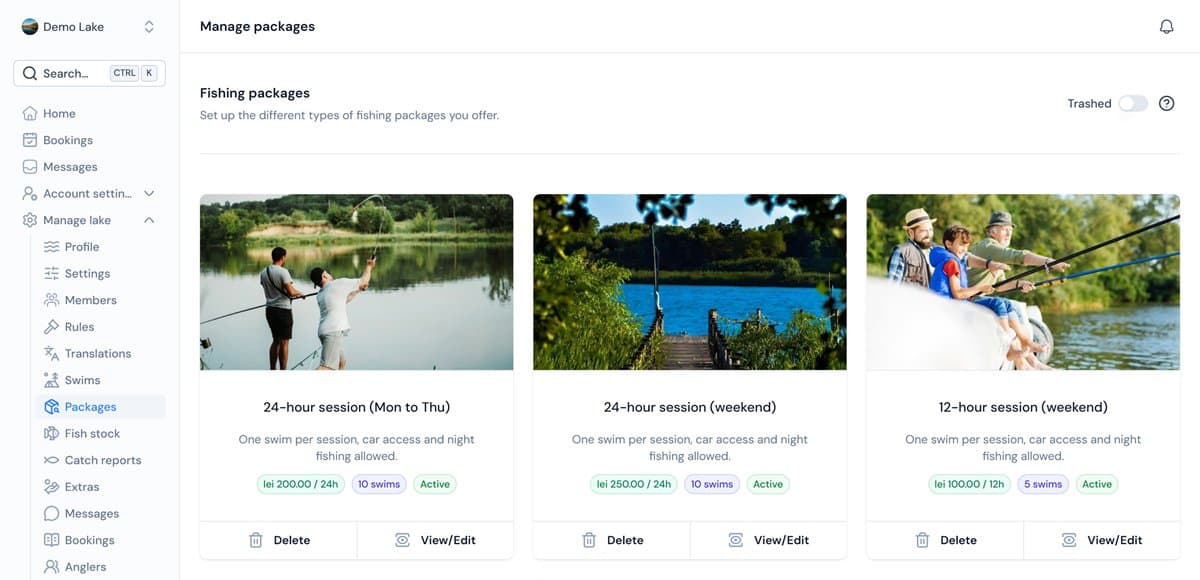
On LakeBooking you can set different session lengths, each with its own check-in times, prices by weekday and by season, a long-stay discount, a promotion on your next bookings, add-ons in seven categories (from boats and bait to food and accommodation), and prices for extra anglers, rods and guests.

Occupancy is the lever you control
You cannot raise prices forever, and fixed costs do not fall much. Occupancy you can move. Empty midweek swims are almost always a lake's biggest untapped profit.
Several things work. Let anglers book online at any hour instead of waiting for a call back. Show up where anglers search, on Google and in lake directories. Collect genuine reviews, lower prices on quiet days and set clear rules, so bookings do not turn into no-shows. There is more in our guides to attracting more anglers to your lake and bookings without no-shows.
Know your numbers
You cannot improve what you do not measure. Every month, look at the occupancy of each swim, how many anglers come back, and how many of the people who view your page go on to book.

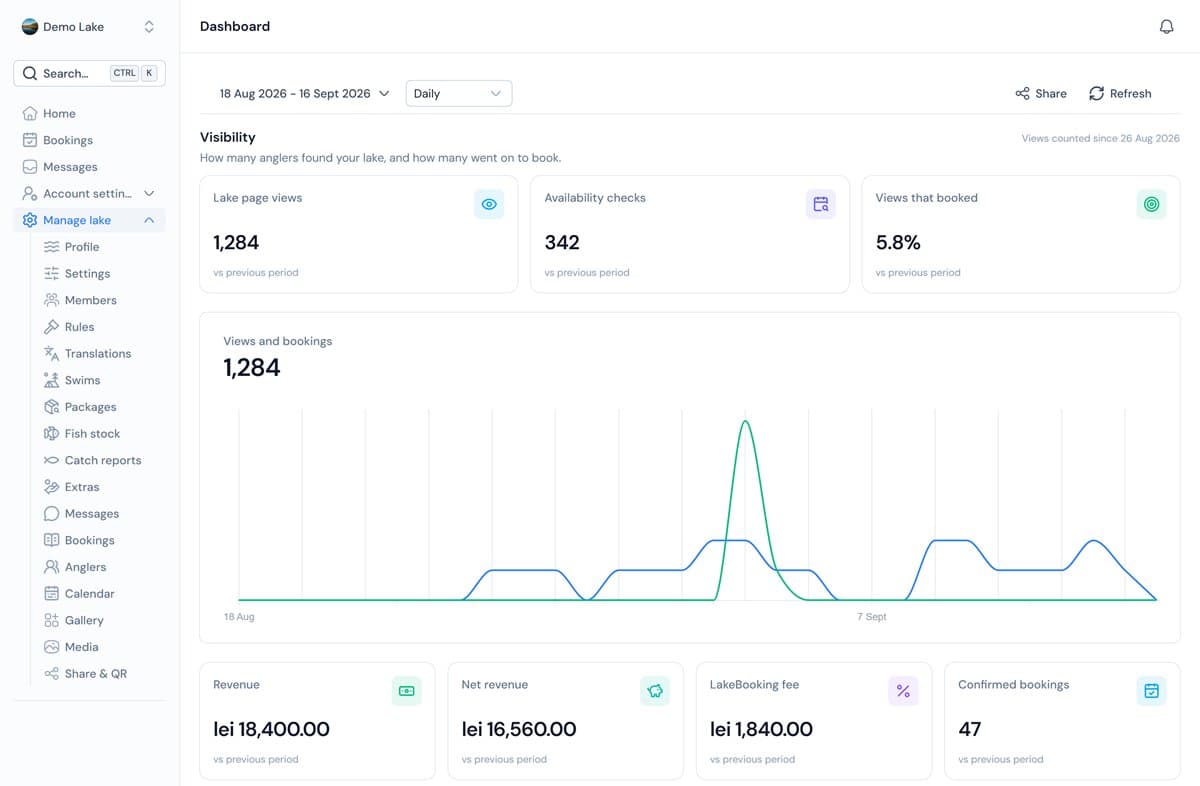
The LakeBooking dashboard shows your page views, how many anglers checked prices and how many booked, revenue, average booking value, occupancy per swim, cancellations, and how many anglers are new and how many return. One honest detail is that the revenue figures are the value of bookings made through the platform, not the cash you actually collected at the lake.
What LakeBooking costs in this model
Listing is free, with no subscription, no listing fee and no paid placement. For each booking made through the platform, the angler pays a 10% booking fee online, included in the price shown, and you collect the other 90% at the lake, in cash or on your own POS. The model assumes half of all bookings come online, so the average fee is 5% of revenue, or 12 lei per booked swim.
It pays off if the platform brings anglers you would not otherwise have had, or fills days that would have stayed empty. At 174 lei left over from each swim-day, 10 more swim-days a month come to about 20,000 lei a year.
Taxes in brief
Tax changes the bottom line a lot, so do the sums with your accountant. In short, for Romania in 2026:
- Micro-company (SRL): 1% of revenue, if you have at least one employee and stay under 100,000 euros of revenue a year. Above that, 16% profit tax applies.
- Dividends: 16% from 2026.
- VAT: mandatory above 395,000 lei of annual takings. The standard rate is 21% and the reduced rate 11% (accommodation, food).
- Sole trader (PFA): 10% income tax, plus health and, above certain thresholds, pension contributions.
The details, with sources, are in our guide to fishing lake permits and taxes.
Fill your empty swims
Listing on LakeBooking is free. You add your swims, packages, weekend and seasonal prices, and anglers book online, day and night. We only earn when you get a booking. No time to set it all up? On the page for lake owners you can ask us to build the listing for you.
List your lake for freeRather start straight away? Create your host account.
Frequently asked questions
Are fishing lakes profitable? They can be. In our model, a 20-swim lake covers its costs at about 19% occupancy and makes about 171,000 lei (about 32,600 euros) profit before tax at 35%. The initial investment takes years to recover, though, and fish kept by anglers can eat a large part of the profit.
How much does it cost to build a fishing lake? From a few tens of thousands of euros for a small pond, before land, to hundreds of thousands for a complex with cabins. Digging, pontoons and stocking are the biggest costs.
How much does a session at a fishing lake cost in 2026? At Romanian lakes that publish their tariffs, a 12-hour session usually costs 100 to 150 lei, a 24-hour session 200 to 250 lei and a 48-hour session 320 to 420 lei per angler.
What occupancy do I need to break even? Divide your annual fixed costs by what a booked swim leaves you after variable costs. In our model that is about 1,115 swim-days a year, or almost 19% occupancy.
How much fish should I let anglers keep? As much as your prices can carry. Every kilo kept has to be replaced at about 20 to 25 lei plus VAT, so sell catch-and-release and retention tickets separately, at prices that cover the fish.
Should I charge more at weekends? Yes, if your weekends fill up. In the model, a price 20% higher on Saturday and Sunday brings about 58,000 lei a year more.
How much does LakeBooking cost? Listing is free, with no subscription. The angler pays a 10% booking fee online, included in the price, and you collect the other 90% at the lake.
About the author
LakeBooking team
Guides for lake owners
We build LakeBooking, the booking platform for fishing lakes, and help owners set up their listings.
Related articles


How to Attract More Anglers to Your Fishing Lake
How to Map a Carp Swim: Feature Finding That Helps
How to use a lead (and a marker if you need one) to find depth, silt, gravel and weed, then put a hookbait on a spot you can hit again.
Fishing Lake Bookings Without No-Shows: A Practical Guide
How to move from phone and WhatsApp bookings to online swim booking, which cancellation rules anglers accept, and how to cut no-shows at your lake.