For Lake Owners
A Complete Fishing Lake Rules Template for Owners
The clauses Romanian fishing lakes put in their rules, what the law says about rules on a private lake, common mistakes and a 16-article template to copy.


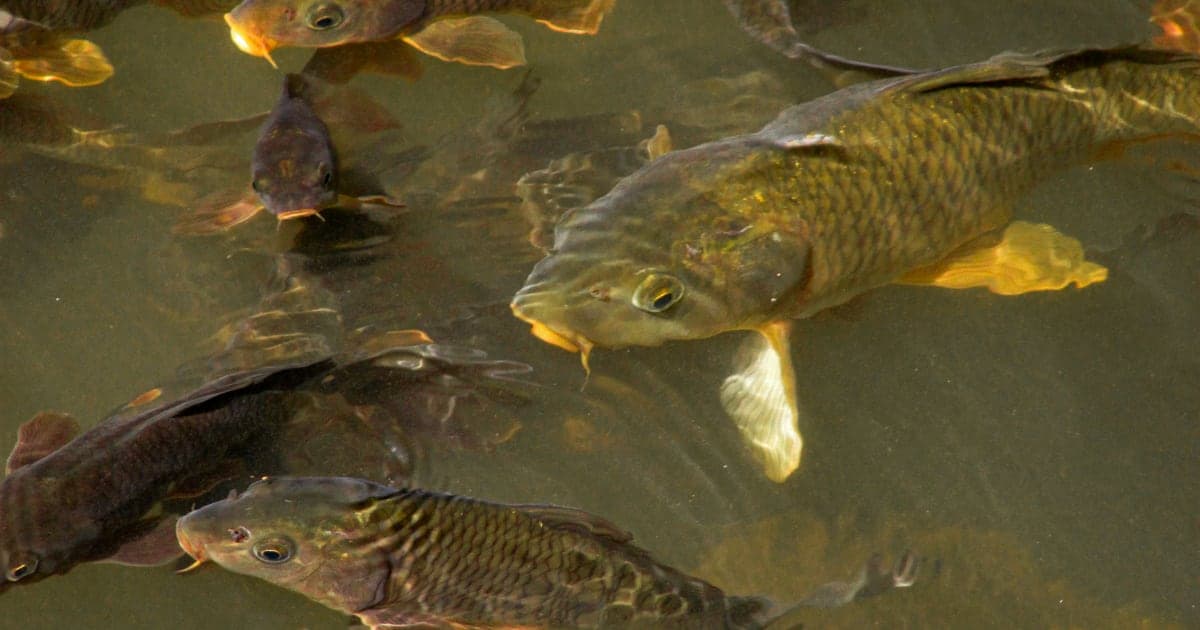
Fish is the only thing the angler comes for, and the only cost of the lake that swims. Stock too little and anglers do not come back. Stock too much and, without feeding and aeration, you lose tonnes in the first heatwave. "How much fish per hectare" is the first question any owner asks when faced with a fingerling quote, and the one the fewest pages answer.
Below you will find a lake's natural capacity, the species that go together and the ones that do not, Romanian fingerling prices from 2025 and 2026 with their sources, a budget per hectare, when and how to transport, and the paperwork the new Romanian aquaculture law requires. The biology travels; the prices and the law are Romanian.
In short, a lake feeds 200 to 500 kg of fish per hectare per year by itself; above a tonne per hectare means daily feeding and aeration. First and second summer stocking carp cost 18 to 22 lei per kilo plus VAT at farms in Călărași county, plus transport. Budget 20% losses on any stocking. Trophy fish are counted in tens of fish per hectare, not hundreds. Stock in spring after the thaw, or in autumn if the lake is over 2 m deep, and ask the supplier for the invoice, the veterinary transport certificate and their registration number.
Every water produces a quantity of natural food (plankton, larvae, molluscs) and, through it, a quantity of fish a year. The reference points used by Romanian fish-farming engineers and by the classic pond literature broadly agree.
| Type of lake | Natural production per hectare and year |
|---|---|
| Plankton-rich lake, silty bottom, warm water in summer | 400 to 500 kg |
| Ordinary lake, second category | 300 to 400 kg |
| Poor lake, cold water or sandy bottom | 50 to 100 kg |
| Neglected lake, overstocked for years | 25 to 50 kg |
A Romanian fish-farming engineer, in an article published as a personal opinion, also describes what happens when you exceed capacity. A second-category lake of 350 kg per hectare, stocked with a tonne of 2 to 3 kg carp per hectare, runs out of natural food in about a month and a half in spring, and a 2 kg carp can weigh 1.5 by autumn. Anglers see thin fish and stop coming. The forum rule for intensively fed lakes is one to two tonnes per hectare as the ceiling, and only with aeration.
For a recreational fishing lake the useful references are three. Without feeding, 200 to 500 kg per hectare; with daily feeding and aeration, one to two tonnes; trophy fish, in tens of fish per hectare. The same engineer gives a guide scale for sport-fishing ponds, 1 kg carp at 150 fish per hectare in spring, with 120 to 130 survivors of 2.5 to 3 kg in autumn; 5 kg carp at about 58 per hectare; 10 kg at 30; 20 kg at 9 to 17. Density stress is, in his view, the main killer of carp above 17 kg, and overstocked lakes lose tonnes in winter.
There is no official Romanian standard for recreational stocking density. The figures above are practice, not a norm. For a new lake, a fish-farming engineer or the research station at Nucet will work out the numbers for your water.
Carp is the base of any Romanian fishing lake and the species the angler wants. Alongside it, a few rules others learned the hard way.
Big carp eat carp fry. One owner who drained his lake after years of stocking small fry found every size class except the ones he had put in. For a fishing lake, stock 1 to 2 kg fish, not larvae.
Romanian farms sell carp by class, first summer (60 to 120 g), second summer (500 to 800 g, sometimes up to 1 kg) and third summer (1.7 to 2.2 kg). The Nucet research station said in 2025 that large juveniles of 200 g reach 2 to 3 kg in a single season, from April to October, and that farms prefer them because birds catch them less. The FAO fact sheet for common carp gives, for the temperate zone, 1 to 2 kg after 2 to 4 growing seasons.
For a fishing lake the sum is simple. First-summer fry is cheap per kilo but expensive per fish once you count how many become catchable. A 1 to 2 kg carp is caught in the first week and pays for itself through sessions. If you want trophy fish, you buy a few large ones, at 25 to 35 lei per kilo, and protect them with your rules.
No Romanian supplier publishes a dated 2026 price list. The best references are the lists of farms in Călărași county, one of them dated, and the classified ads of autumn 2026, which show the live market in October, when farms harvest.
| Fish | Price seen | Source and date |
|---|---|---|
| Romanian first-summer carp, 60 to 70 g | 22 lei per kilo plus VAT | farm in Călărași county |
| Second-summer carp, 500 to 800 g | 21 lei per kilo plus VAT, negotiable above 1,000 kg | same farm, same date |
| First-summer bighead carp | 22 lei per kilo plus VAT | same farm |
| First-summer carp, grass carp, silver and bighead carp | 18 lei per kilo excluding VAT, transport 4 lei per kilometre | a second Călărași farm, undated page read in October 2026 |
| Second-summer grass carp | 20 lei | same farm |
| 2 to 3 cm fry (carp, catfish, zander, crucian, silver carp) | 1,400 lei per lot of 5,000 (carp) or 2,500 (catfish, zander) | farm in Maramureș county, 2026 |
| Catfish and zander fry at 21 days | 2.5 and 1.5 lei per piece | 2017 notice, as an order of magnitude |
| 5 to 9 kg carp for sport fishing | 25 to 35 lei per kilo, by size | notice from around 2021 |
| Classified ads, October 2026 | 20 to 22 lei for second-summer fish, 2 to 3 lei per piece for small fry | unit and VAT not always stated |
Transport is paid separately, usually per kilometre, and serious farms come with their own oxygenated tank. Ask for the quote with VAT, transport and certificate included, otherwise you compare apples with pears. As a control reference, live table carp sold straight from a pond at 28 lei per kilo in October 2026, and take-home lakes sell the kilo above the allowance at 30 to 35 lei, as the guide to catch and release or keep shows.
A worked example with the figures above. It is not a recommendation for your lake but a frame you fill in with your own quotes.
| Scenario for one hectare | Quantity | Estimated cost |
|---|---|---|
| Ordinary lake, no feeding, take-home fishing | 300 kg of second-summer carp, plus a 20% reserve for losses, so 360 kg | 360 kg at 21 lei plus VAT, about 7,600 lei plus VAT, plus transport (100 km at 4 lei, 400 lei) |
| Fed and aerated lake, an angler on every swim on Saturdays | 1,000 kg of 1 to 2 kg fish | 20,000 to 25,000 lei plus VAT at 20 to 25 lei per kilo, plus feed |
| Feed for a tonne of fish, one season | 1% of biomass a day, 120 days, about 1.2 tonnes of feed | at 7 lei per kilo of pelleted feed, about 8,400 lei, before any growth |
| Ten trophy carp of 8 to 9 kg | 85 kg | about 3,000 lei at 35 lei per kilo |
The feed sum starts from fish-farming forum practice (1% of biomass a day, from mid-May to late September, with a weekend break and half rations in heatwaves) and from a carp feed price of 140 lei per 20 kg bag. It is our estimate. Grain-based feed costs less per kilo but converts at 4 to 4.7 kg of feed per kilo of fish and spoils the water.
Technological losses of 20% are not pessimism, they are the norm in stocking manuals. Put them in the budget from the start.
The practical rule from the pond literature is simple. Stock in early spring, after the thaw, when the water is a few degrees and fish transport well. If the lake has good water and a depth over 2 m, you can stock in autumn too, when farms harvest and supply is largest, which shows in the number of classified ads in October. In summer, with water above 20 degrees, transport is risky and fish acclimatise poorly.
Two weeks before stocking, in a drained or new lake, the manuals recommend quicklime (200 to 300 kg per hectare) and fermented manure, plus a water analysis at a laboratory. In a working lake, at least the water analysis.
Most losses happen on the first day, not in the first year. The reference points from Romanian manuals and FAO texts on live fish transport.
Ask the supplier to do the transport with their own tank. A Călărași farm describes its 4 to 5 tonne tank with liquid oxygen and guarantees it loss-free at any temperature. The cost per kilometre is small next to a stocking lost by half.
This is general information, not legal advice; the Romanian legislation below is new and its implementing rules are still changing. Elsewhere, expect the same three layers, an aquaculture or fishery registration, a veterinary registration of the water and a movement document for every delivery. In England, for example, every stocked still water needs a site permit listing the permitted species and suppliers carry a consignment note.
Aquaculture registration. Romania's Law 206/2025 on aquaculture, in force since 7 December 2025, created the "aquaculture registration" for units used only for recreational fishing, issued by the fisheries authority and entered in a public register of aquaculture units. You may keep only the species listed in the registration; adding or removing a species is notified to the fisheries and environmental authorities, and exotic or locally absent species need a permit. Operating without registration and stocking species not admitted are fined 15,000 to 35,000 lei. What the law means for the rest of the lake's paperwork is in the guide to fishing lake permits and taxes.
Veterinary registration. The Romanian veterinary authority's norms treat "sport fishing ponds" as units registered with the county veterinary directorate, with a file and a site visit. An unregistered unit gets no veterinary transport certificate for its fish. The farm checklist requires buying stocking material only from units recognised as free of notifiable diseases. The registration norms were reorganised in 2024, so ask the county directorate directly what file to submit.
The transport certificate. Since June 2026, moving live animals between holdings in Romania requires a veterinary certificate issued by the official or authorised veterinarian, valid for three days and paid by the operator, and the fish diseases checked before certification include koi herpesvirus. Confirm with the veterinary directorate that this is the instrument used for fish. In practice, every stocking needs three papers from the supplier, the invoice, the transport certificate and their registration or authorisation number, and you keep them in the lake's register. A seller who cannot issue the transport certificate is, by definition, outside the system.
An announced stocking is news anglers wait for. Announced a day ahead, with the scale and the tank in the photo, brings bookings the following week and justifies the new year's price. On your LakeBooking lake page, the fish stock appears by species and size class, and anglers see it before booking. Keep it current after every stocking, add photos of the fish delivered and write in your rules which species are kept and which are released, to protect your investment from day one. How the stock ties into the session price is in the guide to fishing lake pricing, and if you are still building the lake, in the guide to how much it costs to build a fishing lake.
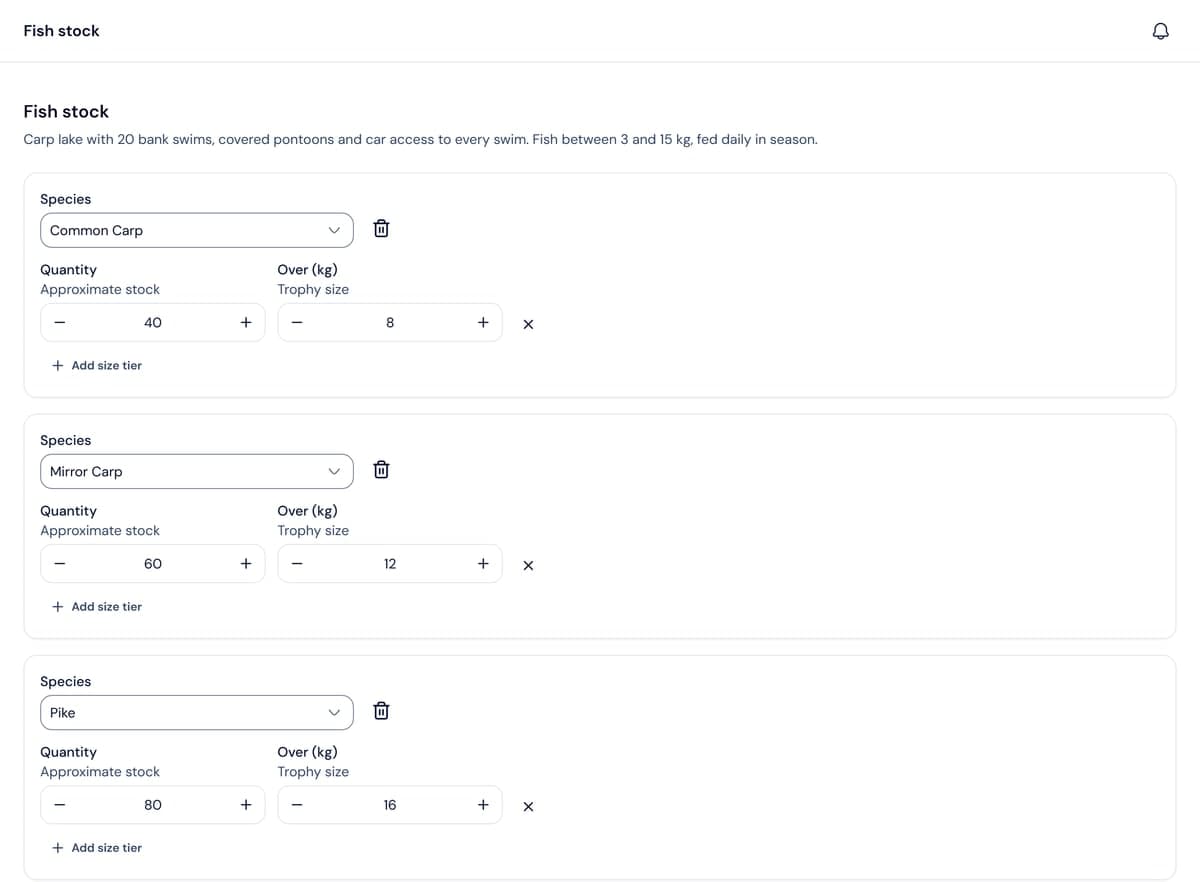
Listing on LakeBooking is free, with no subscription and no listing fee. You fill in your fish stock, swims, packages and rules, and anglers who want 2 kg carp or a trophy in your county find the lake and book online. If you would rather not set everything up yourself, the page for lake owners lets you ask us to build the listing.
List your lake for freeRather start straight away? Create your host account.
How much fish do I stock per hectare in a fishing lake? Without feeding, 200 to 500 kg per hectare, depending on how rich the water is. With daily feeding and aeration, one to two tonnes. Trophy fish are counted in tens of fish per hectare. A fish-farming engineer works out the numbers for your water.
How much do carp fingerlings cost in 2026? Farms in Călărași county listed first and second summer carp at 18 to 22 lei per kilo plus VAT in 2025 and 2026, with transport paid separately, usually per kilometre. Classified ads in October 2026 show 20 to 22 lei for second-summer fish. Ask for dated quotes with VAT and transport.
Do I stock in spring or autumn? Spring, after the thaw, is the rule. Autumn works if the lake is over 2 m deep with good water, and that is when farm supply is largest. In summer, with warm water, transport and acclimatisation are risky.
What paperwork do I need to stock my lake in Romania? The aquaculture registration under Law 206/2025, with the species listed in it, the veterinary registration of the lake with the county directorate and, for every delivery, the invoice, the veterinary transport certificate and the supplier's registration number. Confirm the exact file with the fisheries authority and the county veterinary directorate.
Can I put pike or zander in with carp? Yes, but a season after stocking and in small numbers, because predators eat carp fry. Add them only if you want to sell predator fishing too and if the species are on your registration.
How many fish do I lose at stocking? Manuals budget 20% technological losses per season, and most happen on the first day, at transport and release. Equalised temperature, the salt bath, the acclimatisation enclosure and an oxygenated tank keep losses to a minimum.

About the author
LakeBooking team
Guides for lake owners
We build LakeBooking, the booking platform for fishing lakes, and help owners set up their listings.
Cabins and Pontoons at a Fishing Lake, Worth Building and How to Sell Them
What anglers want from a lake with accommodation, what cabins sell for at Romanian lakes, what they cost to build, when they pay back and the paperwork required.
How Much It Costs to Build a Fishing Lake
The 2026 costs of a new fishing lake, chapter by chapter, the permit chain in order, EU funding and how long it takes until the first paying angler.
Cookies on LakeBooking
We use strictly necessary cookies to sign you in and process payments securely. Optional ones (interactive maps, usage statistics and referral attribution) only run if you agree. Details in our Cookie Policy.