For Lake Owners
A Complete Fishing Lake Rules Template for Owners
The clauses Romanian fishing lakes put in their rules, what the law says about rules on a private lake, common mistakes and a 16-article template to copy.


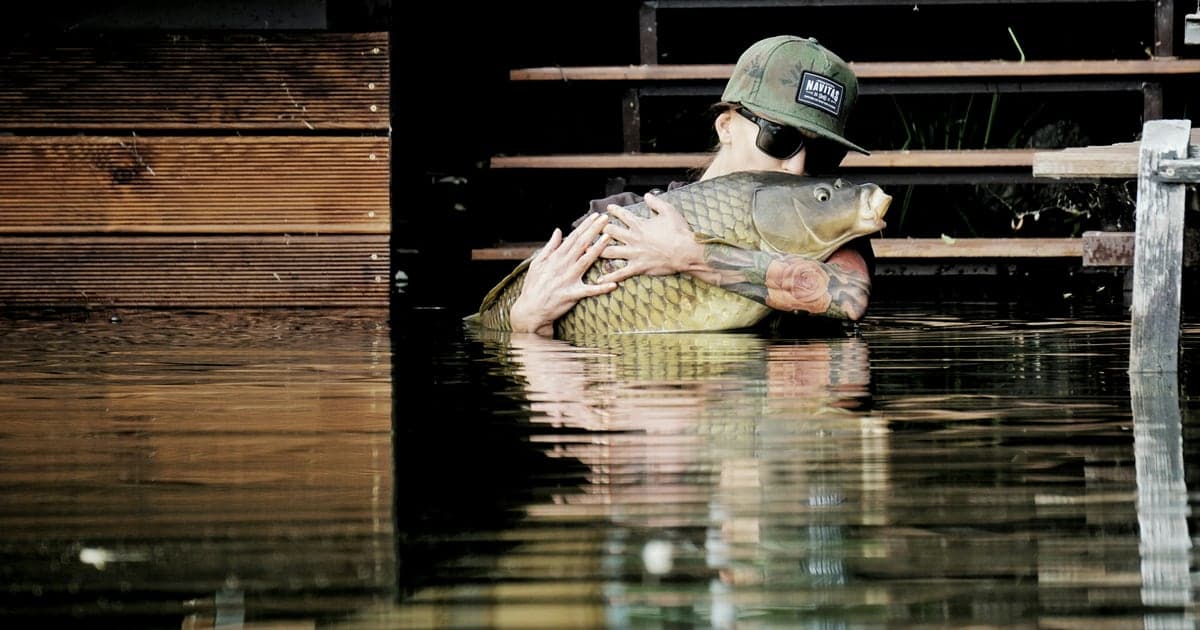
The first decision that places your lake on the market is not the price. It is what happens to the fish once it is caught. A catch-and-release-only lake draws a different angler, needs different rules and a different stock than a lake where the carp goes home in a bag. Many Romanian lakes run both, on separate waters or as two price lines, and not by accident.
Below is how the three models look on Romanian lakes in 2026, what anglers want, what a kept fish really costs you, the rules that hold each model together, and a short decision guide. The figures are Romanian; the reasoning applies to any fishery that sells sessions.
In short, the angler who wants fish for the table picks a take-home lake close to home, while the specimen carp angler comes on purpose, for fish they know you have. On mixed lakes the take-home line costs 25 to 35% more than the catch-and-release line, sometimes double. Most owners cap retention at 5 kg per 12 hours and 10 kg per 24 hours, with a keepable window between 1 and 4 or 5 kg. Stocking carp of 1 to 2 kg costs around 20 to 25 lei per kilo plus VAT, and on the bank it sells for 30 to 35 lei, so the margin on kept fish is thin. If you have one water, the mixed model with two price lines is the safest place to start.
We read the tariffs and rules published by a number of Romanian lakes and the way guides for carp anglers tag lakes by regime. Three models cover almost everything.
Guides written for specimen anglers lean towards catch and release, with almost half the lakes they recommend catch-and-release-only, a third mixed and the rest take-home-only. On the ground, the mixed model dominates.
Two things stand out in how anglers choose.
Tactics articles for take-home lakes say plainly that most Romanian anglers want to take at least one carp home. On the forums the argument is not whether retention is right, but which model is fair. Many prefer "a fishing fee, then weigh the fish at the end and pay" over an included allowance they do not fill. The most common complaint is exactly that one. The angler paid the line with 5 kg included and caught a 3 kg carp.
For you that means two distinct audiences. Families and occasional anglers choose take-home for the meal and the fixed price. Carp anglers choose catch and release for the big fish, accept 3 to 5 minute handling rules and pay more per night for it.
A kept fish is not revenue, it is goods sold. The sums matter.
What it costs to put in. A fish farm in Călărași county lists second-summer carp of 500 to 800 g at 21 lei per kilo plus VAT, invoiced with a certificate of conformity. For 1 to 2 kg fish, delivered, a working figure is 20 to 25 lei per kilo plus VAT. Get fresh quotes from two farms before you run your numbers, because prices move from one season to the next.
What you get for it on the bank. On 2026 tariff pages of lakes around Bucharest and in Prahova, carp above the allowance, or sold by weight, costs 30 to 35 lei per kilo. Older or provincial listings show 14 to 22 lei. Crucian carp sells for 10 to 20 lei.
What is left. Between 20 to 25 lei plus VAT at purchase and 30 to 35 lei at sale sit transport, losses in the first weeks, feed and fish that leave without being weighed. The margin on a kept kilo exists, but it is thin. The take-home line pays through the higher session price and the angler who comes back, not through fish sales.
What a released fish is worth. According to the FAO fact sheet for common carp, in the temperate zone carp reach 1 to 2 kg after 2 to 4 growing seasons, and a Romanian farm quoted about 2 kg at three years. A 1 kg carp released today needs one more summer to reach the 2 kg class and two to three summers to reach 4 or 5 kg in a fed lake. That is why nearly every take-home lake protects its bigger fish. The keepable window has a floor, usually 1 kg, and a ceiling of 4 or 5 kg, above which the carp is photographed and released. A few lakes reward releasing a fish above the ceiling with a free session.
How many fish die in catch and release. Carp are among the hardiest species. A 2023 study in Fisheries Research followed 127 carp caught on hook and bait. Three died within the first hour, all after heavy bleeding and all on small hooks. A 2012 study in the same journal recorded no deaths over two months of observation after angling and sack retention, but measured clear stress from retention. A 2005 review of 274 estimates across all species gives a median hooking mortality of 11%, with hook location as the main factor. For an owner the conclusion is that catch-and-release losses run at a few percent when fish are mouth-hooked and handled quickly, and the factors you control through your rules are hook size, time on the bank, retention sacks and water temperature.
The figures below come from the lake pages we read in October 2026, not from a market statistic. They show where the angler expects to find you.
| What you set | What appears most often | Variants seen |
|---|---|---|
| Included take-home allowance | 5 kg of carp per 12 hours, 10 kg per 24 hours | 3 to 4 kg on small lakes, 8 to 10 kg on heavily stocked ones |
| Lower limit for keeping | 1 kg | 300 g, 1.2 kg, 1.5 kg |
| Ceiling above which fish are released | 4 to 5 kg | 3 kg, 3.5 kg, 6 kg, 8 kg |
| Carp above the allowance, or sold by weight | 30 to 35 lei in 2026, in the south | 14 to 22 lei on older or provincial lists |
| Crucian carp | 10 to 20 lei per kilo | included without limit on many lakes |
| Dead or injured fish on catch-and-release lakes | 40 to 100 lei per kilo | a penalty in the rules, not a sale price |
| Reward for releasing a fish above the ceiling | a free 12-hour session | a 24-hour session above 10 or 12 kg |
The price gap between the two lines on the same lake runs from 25% to double. At one lake, 60 against 80 lei per 12 hours. At another, 80 against 160. At a third, 120 against 150 per 24 hours. Most often the take-home line costs 25 to 35% more. The catch-and-release discount is, in effect, the price of the fish the angler does not take.
Dedicated trophy basins run the other way. They cost more than any take-home line, because there the angler pays for access to big fish and for quiet, not for the fish.
Catch and release. The rules of lakes that run this way look alike, because they protect the stock. A cradle-type unhooking mat and antiseptic spray are compulsory, the landing net has fine mesh and a minimum width of one metre, retention sacks are banned or left in the car, the photo and release happen within 3 to 5 minutes, staff are called for very large fish, and a dead fish costs a penalty per kilo. Carp-care guides add a wet mat, a bucket of lake water and antiseptic on hook holds. Write these into your rules and post them at the gate, because the carp angler reads them first.
Take-home. Here the rules are about the scales and the money. Where and when fish are weighed, what happens to fish under the floor or over the ceiling, what an extra kilo costs, which species are never kept (sturgeon and fish over the ceiling, as a rule) and how payment works. A visible scale and a receipt for every kilo sold avoid arguments at the gate.
One detail few owners treat as such. A kilo of carp sold at departure is not a fishing fee, it is a sale of food of animal origin. In Romania, ANSVSA Order 111/2008 treats fish from fish farms as a primary product that may be sold directly to the final consumer after sanitary-veterinary registration with the county DSVSA, and the amount goes on a fiscal receipt or invoice like any sale. Ask the county authority and your accountant before you put a per-kilo price on the board. This is general information, not legal or tax advice.
Mixed. On one water with two price lines, the critical rule is a single one. The angler chooses the line at arrival, not at departure. Otherwise everyone pays catch and release and asks for retention once they catch. On separate basins, the rules above apply to each basin.
In Romania, the statutory limits for recreational fishing (5 kg per angler per day, or a single fish if it alone exceeds 5 kg, plus minimum sizes such as 40 cm for carp) are written for natural waters. For managed fisheries, Emergency Ordinance 23/2008 provided that recreational fishing takes place "under the conditions and rules set by the licence holder", so retention, size and species rules were the owner's to set. Law 176/2024 replaced that ordinance, and Law 206/2025 introduced an aquaculture registration for lakes used only for recreational fishing. Read the matching article of the new law or ask the fisheries authority before writing in your rules that you set the limits yourself. The closed season applies to natural waters, and managed lakes take anglers in April and May, exactly when public waters are shut. The paperwork your lake needs is in our guide to fishing lake permits and taxes. Elsewhere, check your national rules on removing coarse fish and on selling fish by weight; both vary widely.
Answer five questions, in this order.
For most lakes with a single water, the practical answer is the mixed model with two price lines, a modest included allowance (3 to 5 kg per 12 hours), a clear keepable window (1 to 4 kg) and a per-kilo price for anything above. If you have two waters, separate them. A take-home lake for families and a catch-and-release lake for carp anglers, with different prices and rules. Move to full catch and release only when your stock of big fish and the anglers who come for it cover the higher session price.
How these choices feed into the session price is in our guide to setting fishing lake prices, and the full list of bank rules, with a template to copy, is in the fishing lake rules template. The fish you start with, and what they cost, are in the guide to stocking a fishing lake.
On LakeBooking, every package has its own catch policy, so you can publish a catch-and-release line and a take-home line on the same lake, each with its price, length, check-in times and rules. The angler picks the line when booking, not when leaving, and the package they chose appears on the booking and in your dashboard. The fish stock, by species and size class, shows on the lake page, and the full rules are shown before payment. Your lake stats show which package sells and on which days, so you can adjust the allowance or the gap between the lines after a season, not after an impression.
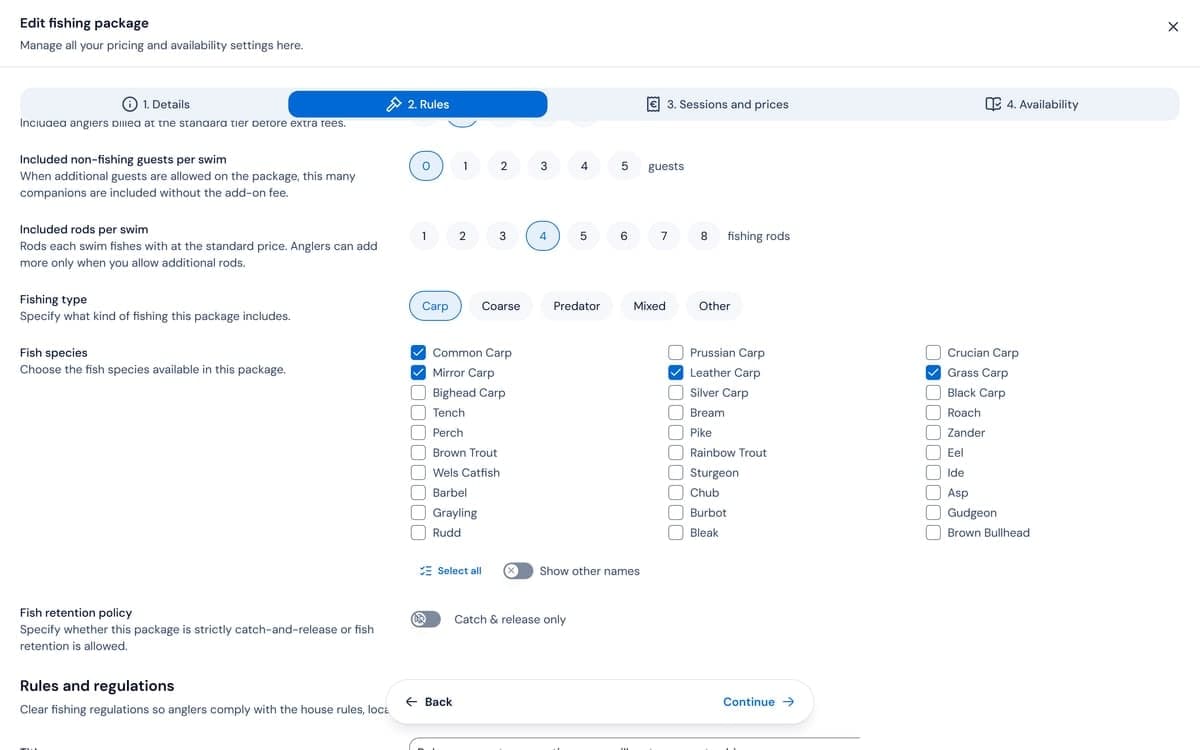
To see how lakes that already publish both lines present them, browse the lakes already listed.
Listing on LakeBooking is free, with no subscription and no listing fee. You set up your packages with each one's catch policy, prices and rules, and anglers who want take-home fishing or big fish in your county find exactly the right line and book online. If you would rather not set everything up yourself, the page for lake owners lets you ask us to build the listing for you.
List your lake for freeRather start straight away? Create your host account.
Which model makes more money, catch and release or take-home? It depends on stock and anglers. The take-home line sells for 25 to 35% more on the same lake, but it consumes fish you buy at 20 to 25 lei per kilo plus VAT. A catch-and-release basin with big fish sells for the most of all, but only once you have the fish and the anglers who come for them.
How much fish should the take-home price include? The market reference is 5 kg per 12 hours and 10 kg per 24 hours. Small lakes include 3 to 4 kg, heavily stocked ones 8 to 10 kg. Above the allowance, 30 to 35 lei per kilo of carp in 2026 in southern Romania.
Can I set my own retention limits on my lake? On Romanian managed fisheries the recreational fishing rules were set by the licence holder under Emergency Ordinance 23/2008. Law 176/2024 replaced it, so check the text in force or ask the fisheries authority. The legal 5 kg per day limit and the minimum sizes are written for natural waters.
Do I need to issue a receipt for fish sold by weight? Yes. A kilo sold at departure is a sale, not a fishing fee, and fish from fish farms is a product of animal origin subject to sanitary-veterinary registration. Ask the county veterinary authority and your accountant before you post a per-kilo price.
How many fish die in catch and release? Few, when the rules are followed. A 2023 study of 127 carp recorded 3 deaths in the first hour, all after bleeding on small hooks. The mat, the antiseptic, release within minutes and no retention sacks are the rules that keep losses at a few percent.
Can I run both models on the same lake? Yes, and it is the majority model in Romania. Two price lines, chosen at arrival, with separate rules. On LakeBooking each package has its own catch policy, so you publish both on one page.
What do I do with a fish above the ceiling that the angler wants to keep? Most lakes make its release compulsory, after a photo, and some reward the release with a free session. A 5 kg carp sold once brings 150 to 175 lei. The same carp in the lake brings anglers back for years.

About the author
LakeBooking team
Guides for lake owners
We build LakeBooking, the booking platform for fishing lakes, and help owners set up their listings.
Where to Take Fishing Lake Bookings? Phone, Facebook, Your Site or a Platform
How Romanian fishing lakes take bookings, what each channel costs in money and time, its risks and how to combine them in one calendar.
Cabins and Pontoons at a Fishing Lake, Worth Building and How to Sell Them
What anglers want from a lake with accommodation, what cabins sell for at Romanian lakes, what they cost to build, when they pay back and the paperwork required.
Cookies on LakeBooking
We use strictly necessary cookies to sign you in and process payments securely. Optional ones (interactive maps, usage statistics and referral attribution) only run if you agree. Details in our Cookie Policy.